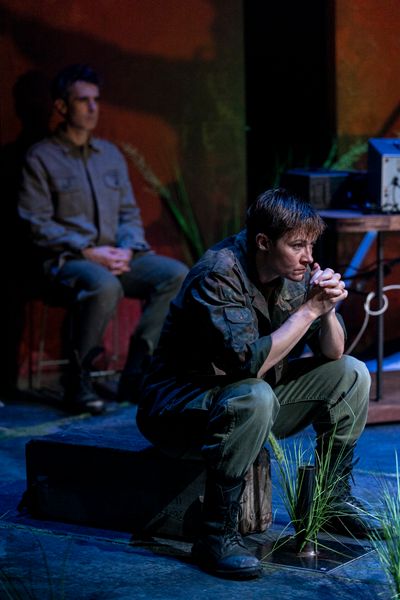

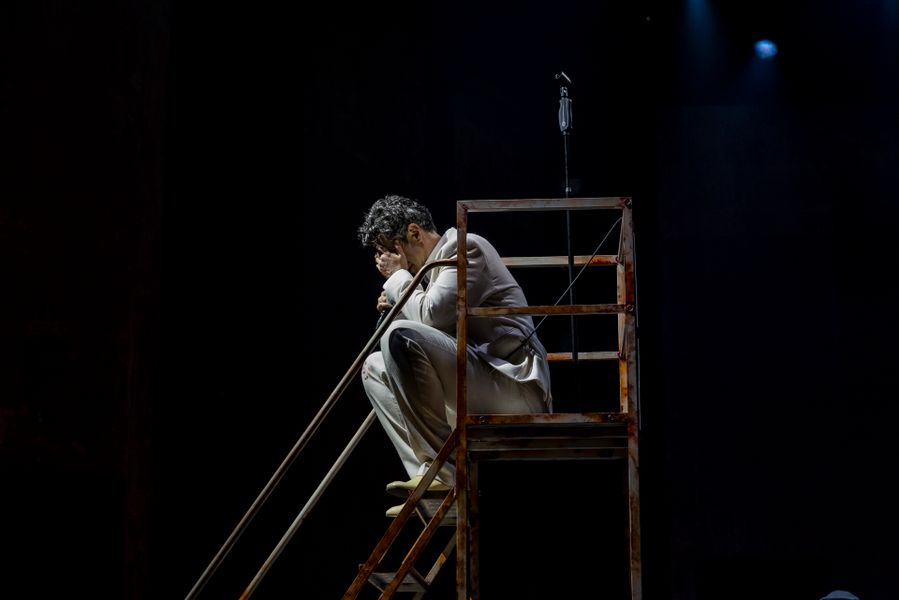
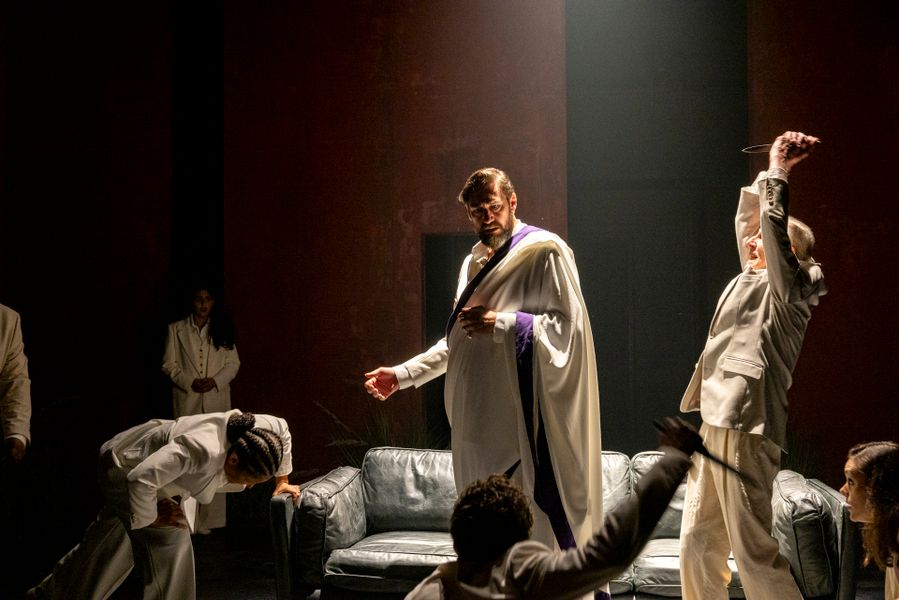
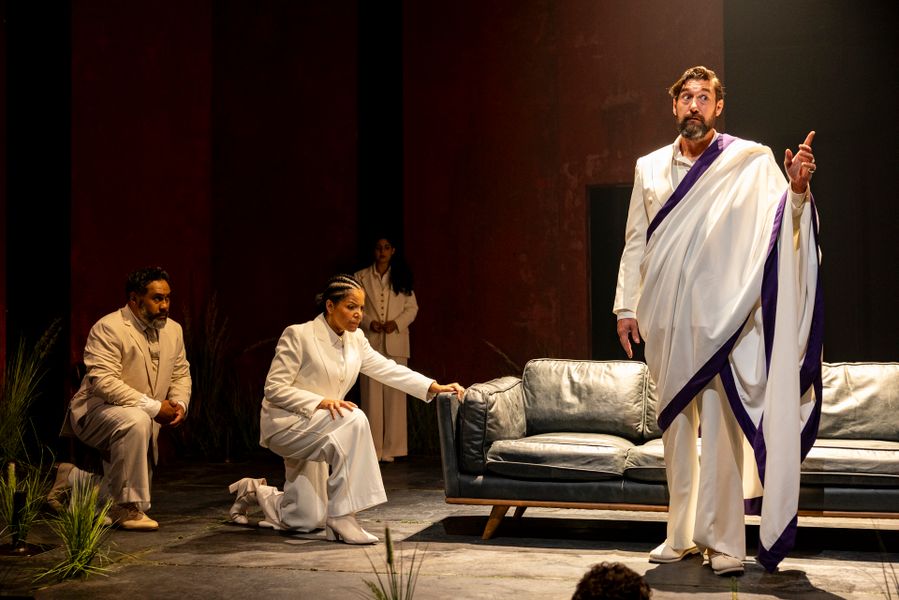

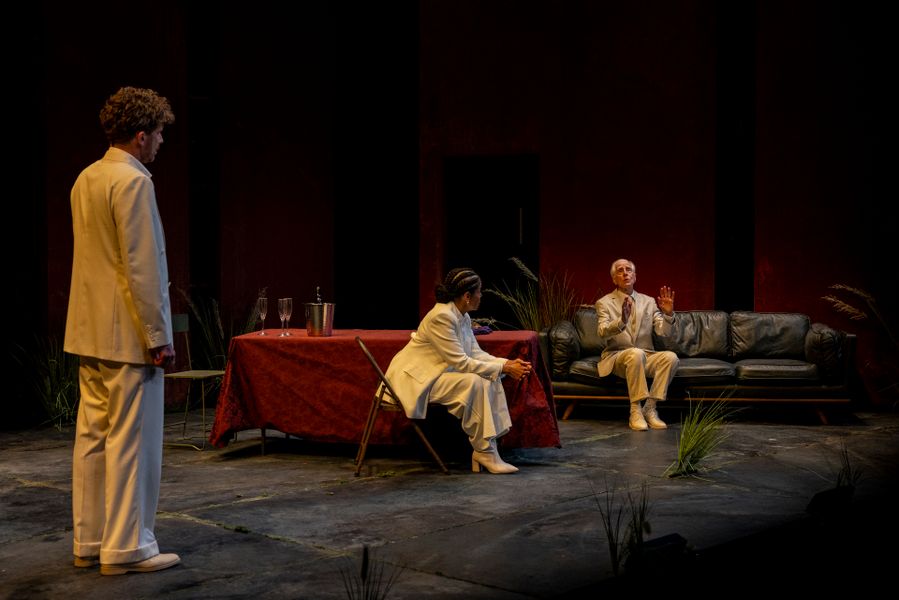

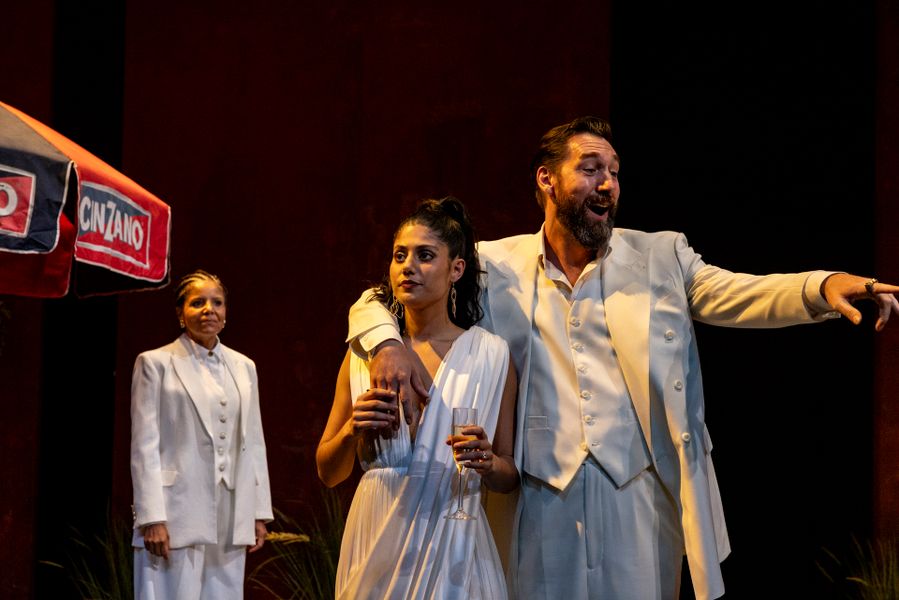
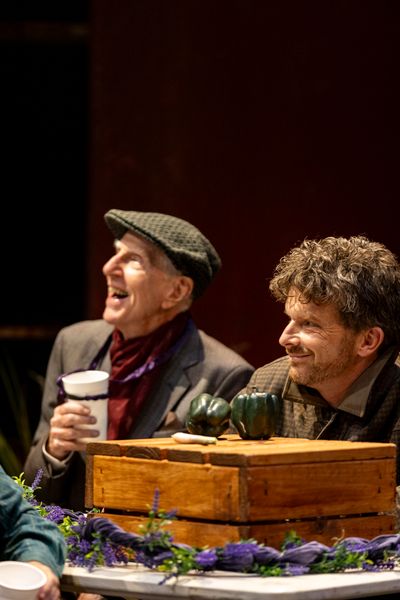
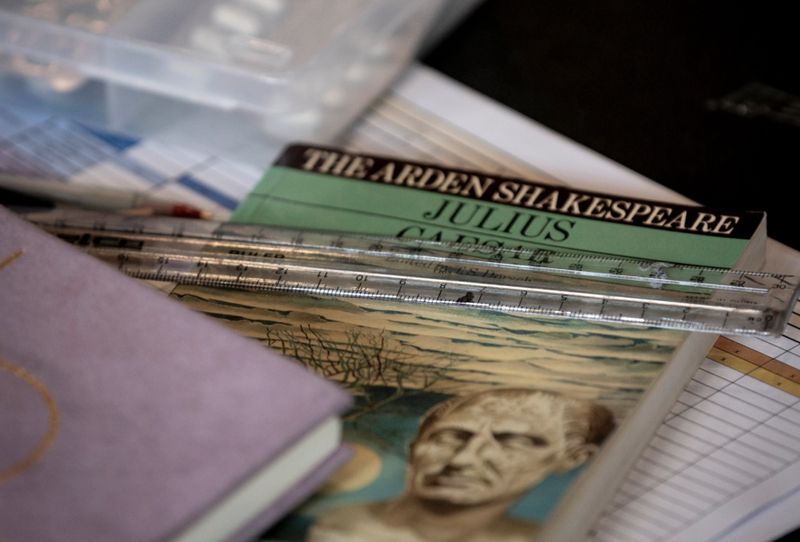
An essay written by Andy McLean for the program of Bell Shakespeare's production of Julius Caesar.
We live in a time of soundbites, social grabs and short attention spans, but political leaders still know that speeches win hearts and minds. In fact, the art of rhetoric in public speaking could be more powerful today than it was in Julius Caesar’s time.
Today you could have stayed at home on the couch, glued to Netflix or TikTok (or both). But instead you chose to come to this theatre. Why?
For many of us, part of the answer has something to do with the buzz of live performance. Watching a screen, it’s hard to recreate the special energy that crackles in a roomful of actors and audience members. And that’s how science explains it too.
A study by University College London found theatregoers’ heart rates changed approximately twice as much as those watching film. It appears that human hearts start to synchronise in theatre audiences, and we feed off each other’s responses to the actors on stage.
Educational neuroscientist Dr Jared Cooney Horvath says the hormone oxytocin, which is the foundation of empathy and trust, is more easily activated in person than via digital media. According to his research, people’s brain activity harmonises when they are together in the same place, “a process known as ‘neural coupling’ that leads them to not only learn from one another but quite literally think alike.”
The science makes sense given that humans evolved for millennia by communicating in person, not through screens. And it helps explain why public speeches can still cut through the digital din of Insta Reels and YouTube Shorts.
In Munich last year, a scorched-earth speech by US Vice President JD Vance left his audience of European allies both admonished and astonished. Then at Davos in January, Canadian PM Mark Carney presented a counter view that sent shockwaves through a room full of international leaders.
Those two speeches were totally at odds politically, but they were part of the same long tradition of rhetorical study. Philosophy professor Angela Hobbs points out that the art of speaking persuasively has been admired at least as far back as Homer, who likely lived in the 8th Century BCE.
Later, the use of rhetoric triggered moral panic in Plato, who argued it was dishonest and “it must not, if we can help it, strike root in our society.” But his hopes were in vain.
By the time the Romans rose to power, the discipline of public persuasion was much admired, according to English professor Ceri Sullivan. “[I’-n Rome] the political aspect of rhetoric is seen not as an abuse by the clever of the weak or stupid … but a way of negotiating, a way of understanding that your audience must be with you when you’re attempting to govern them.”
Centuries later, when William Shakespeare wrote The Tragedy of Julius Caesar, he was already well versed in the tools of rhetoric. They had been part of his school curriculum. And his play is littered with language designed to sway crowds, secure consent, and reshape people’s understanding of reality.
The assassination of Caesar in the Senate may be the point of no return for Shakespeare’s conspirators, but it’s the following two public speeches at his funeral which seal the fates of everyone in Rome.
First comes Brutus, who is confident the Roman masses can be persuaded that Caesar had to die. Like Brigid Zengeni in today’s Bell Shakespeare production, actor Harriet Walter played the role of Brutus as female in 2012. Walter says Brutus’ speech employs an array of technical devices including repetition, emotional appeals and rhetorical questions to position herself as a patriot – not a murderer.
Walter points out that Brutus’ speech builds from logical argument to emotional blackmail, culminating in a call for unity. And it’s packed with antithetical soundbites that capture her key messages:
“Not that I loved Caesar less, but that I loved Rome more”
“Had you rather Caesar were living and die all slaves, than that Caesar were dead, to live all free men?”
Technically speaking, Brutus delivers a fine speech and initially the crowd is convinced. But Brutus has made a fatal error. Literally. Having earlier spared the life of Caesar’s right-hand man Mark Antony, she now departs and grants him the chance to deliver a eulogy.
Antony’s speech swiftly moves the crowd from acceptance of Brutus’ explanation to furious rebellion. From the first line onwards, it’s an absolute masterclass in rhetoric. Writer and critic Sam Leith points out that “Friends, Romans, countrymen, lend me your ears” appeals first to friendship, then to civic duty as Romans, and finally to a communal sense of countrymen. It’s one of the oldest tricks in the book – in the 4th century BCE, Aristotle identified this tactic as “ethos”.
Antony goes on to display a variety of linguistic acrobatics, while denying that he knows what he is doing:
“I am no orator, as Brutus is;
But, as you know me all, a plain blunt man
That love my friend.”
This is disingenuous on Antony’s part – he’s a sensational orator – but the crowd swallows it hook, line and sinker. In those three lines, he reinforces his relationship with the common folk and distances Brutus from them.
As well as establishing his own connection with the audience, Antony connects them to Caesar and his legacy, too. He uses what speechwriters call “concrete language” to paint a picture in the audience’s minds of the “private arbours and new-planted orchards” Caesar has bequeathed to the public. And Antony uses a tactic that Aristotle identified as “pathos” to stir the audience’s emotions:
“My heart is in the coffin there with Caesar”
Antony also shows a knack for stagecraft. He’s disobeyed an earlier instruction from Brutus to “Prepare the body” of Caesar and instead kept it in the gory state the conspirators left it in. Now, during his oration, Antony reveals Caesar’s wounds to the audience – and he names names – vividly describing the bloody damage inflicted by Casca, Cassius and Brutus.
As well as ethos and pathos, Aristotle would also recognise Antony’s use of “logos” to persuade the crowd. Sam Leith explains: “Logos is the argument itself – the evidence weighed, the conclusions drawn, and the thumbs on the scales,” which can be seen in Antony’s shrewd attempt to square the evidence he presents in his speech with the axiom that the conspirators are “all honourable Romans”.
Antony’s rhetorical prowess is all the more remarkable when you consider the emotional turmoil he’s been thrust into. Brutus knew the assassination was coming and had some time to prepare his speech. But Antony is in a state of shock. After witnessing his friend’s traumatic death, he’s now confronting a new reality where Caesar is not “constant as the north star” but gone forever.
In many ways, Antony’s raw emotional state mirrors that of his fellow Romans. Neuroscience might suggest his heart has synchronised with theirs. A more political interpretation is offered by US national security analyst Ben Rhodes:
“If you look at both Lincoln and Kennedy after they were killed, people felt like we didn't appreciate them enough while they were here. That's one emotion. Another emotion is somehow, ‘We did this. If the great man was killed, something must be wrong with us, and we must therefore strive to be like the greatness inside of the person we lost.’ And that's exactly what Mark Antony's message was.”
Shakespeare goes to great lengths to show us just how extraordinary Caesar’s fall is. A series of prophesies and uncanny events precede the assassination, from soothsayer warnings to fire raining from the sky. Chaos is already in the air before the conspirators strike, so it’s no wonder the Roman people feel vulnerable when Caesar dies. During his eulogy, Antony shares their fear and understands their need for certainty, steering them towards a solution: mutiny.
From ancient Rome to Elizabethan England to modern-day Australia, rhetoric remains a potent force in political life. Perhaps now more than ever, when people consume so much fractured digital chatter.
“[Nowadays] when a speech does break through, it’s almost more important,” says Rhodes. “The desire for an audience to want someone to give meaning to an event that they don’t understand is still with us. When big events happen, when there’s a large political event, there is still that desire for somebody to explain it.”
Andy McLean is a freelance writer, podcaster and presenter based in Sydney. swashandbuckle.com.au