
Bell Shakespeare.

2009 The Taming Of The Shrew
  • INTRO.

    BY WILLIAM SHAKESPEARE
    DIRECTED BY MARION POTTS

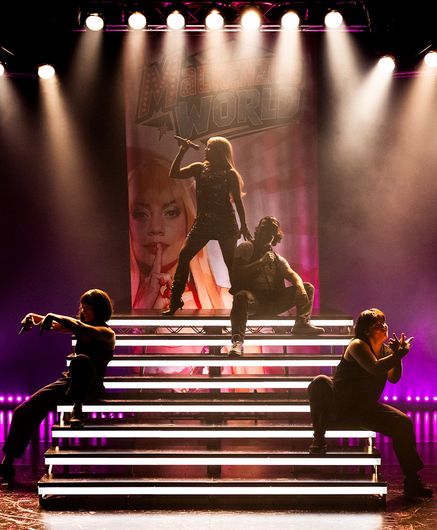
    Disco balls, karaoke and a daring all-female cast tell the story of a woman no 'man' can contain. While Lucentio fixes his gaze on sweet and gentle Bianca, Petruchio sets his sights on Bianca’s wanton sister, Kate, and vows to tame her.

    Directed by Marion Potts (Othello, Hamlet, Venus & Adonis), this new production of Shakespeare’s controversial comedy takes the politics of marriage to ludicrous heights. Witty, energetic and packed with female punch, The Taming Of The Shrew is the perfect night out for anyone who has ever fallen in love – and managed to survive it.

    The performance runs approx. 2 hours 45 minutes, including a 20 minute interval.

  • SYNOPSIS.

    A rich merchant of Padua, by the name of Baptista, is keen to find husbands for his two unmarried daughters. Bianca, the youngest, has no shortage of suitors. Gremio and Hortensio are already hanging about in the hope of wooing her when Lucentio, a gentleman of Pisa, arrives in Padua to study and upon seeing Bianca decides to win her for himself.

    But Baptista is concerned about his eldest daughter Katherina – ‘the shrew’ – whose feisty and troublesome nature makes her more difficult to offload. He insists that Bianca will remain single until a husband is found for Katherina. Lucentio swaps identities with his servant Tranio and gets a job as Bianca’s tutor so he can be close to her.

    Hortensio’s friend Petruchio is in town from Verona, and agrees to help his friend by marrying Katherina – a prospect made more attractive by her healthy dowry. At their first meeting, Katherina protests angrily, as is her wont, but Petruchio takes no notice and insists that she be his wife.

    Baptista is delighted, and leaves the other fellows to fight it out among themselves for Bianca’s hand. Lucentio, in his disguise as tutor, seems to be making progress with Bianca. Hortensio and Gremio are disgusted by her apparent reciprocation and decide to court her no longer.

    At the wedding, Petruchio shows up late – and badly dressed – and is ill-behaved throughout the ceremony. He won’t stay for the reception, despite his new wife’s wishes, and instead carries Katherina off to his country house where he withholds food, clothing and even a comfortable bed until she submits herself entirely to his will.

    Meanwhile, Lucentio must persuade Baptista that he comes from a wealthy family. Tranio employs a willing opportunist to stand in for Lucentio’s father, Vicentio, which does the trick, and Lucentio and Bianca elope.

    On their way back from their less than harmonious honeymoon, Katherina and Petruchio run into the real Vicentio, who accompanies them to Lucentio’s house. The impostor and Tranio denounce Vicentio as a villain, but the arrival of his son, Lucentio, narrowly saves him from being carted off to gaol. The identity scams and Bianca’s marriage are all revealed, and everyone’s parents accept the arrangements.

    The husbands, gathered to celebrate at a combined wedding reception, place bets to see which of their brides, celebrating in another room, is the most obedient and will appear at their bidding. Katherina enters the room – the only one to come at her husband’s call. She chides the other women, delivering a speech on the virtues of wifely obedience.

  • CAST & CREATIVE.

    Director – Marion Potts
    Designer – Anna Trelogan
    Lighting Designer – Paul Jackson
    Composer / Sound Designer – Max Lyandvert
    Fight Choreographer – Scott Witt
    Assistant Director – Shannon Murphy

    Hortensio – Beth Aubrey
    Bianca – Emily  Rose Brennan
    Petruchio – Jeanette Cronin
    Gremio / Haberdasher – Vanessa  Downing
    Biondello / Widow – Judi Farr
    Baptista – Sandy Gore
    Lucentio / Curtis – Luisa Hastings Edge
    Grumio – Anna Houston
    Tranio – Ksenja Logos
    Kate – Lotte St Clair
    Vincentio / Tailor – Wendy Strehlow

  • REVIEWS.

    Daily Telegraph
    Stephen Downie
    26 October 2009

    Gender on the agenda


    It is Shakespeare’s gloves-off battle of the sexes – only this time all the roles are played by females. In so doing, director Marion Potts’ The Taming Of The Shrew, for Bell Shakespeare, aims to steer audiences away from the more notoriously misogynistic elements of the play and focus more on the central characters’ power tussles.

    The production is a winner, with superb performances all round. Yet many members of the audience will feel uncomfortable as they leave the theatre.

    Sure, we can all laugh at Petruchio’s antics, particularly as Jeanette Cronin ramps up the character’s macho tendencies, pelvic-thrusting and slurping vigorously from a bottle.

    But no amount of boisterous behaviour by the actors playing men can soften either the “taming” scene or Katherina’s final speech.

    The setting is what appears to be an RSL or club, complete with tacky karaoke machine, which allows the characters to break, perhaps a little too often, into cheesy 1980s tunes.

    The story centres on rich mafioso-type Baptista (Sandy Gore) trying to marry off his two daughters, the younger, almost bimbo-like Bianca (Emily Rose Brennan) and her feisty, ill-tempered and somewhat contrary older sister Katherina (Lotte St Clair), the so-called shrew.

    There is no shortage of suitors for Bianca but most are wary of her sister.

    The trouble is, Baptista won’t allow Bianca to be married until a partner has been found for Katherina.

    So, money-hungry Petruchio hatches a plan with friend Hortensio (Beth Aubrey) whereby he will marry Katherina so his pal can take Bianca.

    Katherina doth protest but eventually succumbs. Then comes the awkward scenes in which Petruchio cruelly deprives her of food, sleep and attention to bring her into line.

    Towards the end she delivers a speech that seems to indicate she has mellowed. Some feminists argue she becomes the submissive wife. Others say the playwright had his tongue firmly planted in this cheek with this play.

    Long may the debate rage.


    Sydney Morning Herald
    Jason Blake
    24 October 2009

    All-female cast puts Shakespeare's chauvinism in its place


    Without castrating the play, there is no sidestepping the chauvinism of Shakespeare's most troublesome comedy. With an all-female cast, however, the director Marion Potts's Shrew shows her audience a way past their gag reflex.

    Anna Tregloan's set design is more Padstow than Padua, a dreary, time-warped reception hall - complete with karaoke machine - that confers an air of daggy familiarity. Poker chips and playing cards are scattered on the tables. It is a place where deals are done, perfect for the wealthy Baptista (Sandy Gore in suburban Mafioso mode) to auction daughters Kate and Bianca to the highest bidder.

    Little wonder that feisty, quarrelsome Kate (Lotte St Clair) is intrigued by Petruchio (Jeanette Cronin) from the minute he leaps into the room. Twitchy and livewired - cocky gait, backcombed barnet, tight pants - Petruchio is obviously no stickler for convention. Compared to Lucentio, who cooks up a role-swapping ruse with the manservant Tranio to secure Bianca (a bubbly Emily Rose Brennan), he is comparatively straightforward.

    What you see is what you get, although his cross-dressing antics at their betrothal suggest he will not be entirely wedded to the conventional dynamics of marriage once the deal is done.

    The actresses man up very effectively. The earnestness and attention to detail to the gender play mean the audience quickly accepts the inversion.

    Gore is particularly good, adding a measure of tonal depth and stillness to proceedings that can get a little shrill. Cronin mugs extravagantly but is frequently hilarious. The major subplot, in which Lucentio (Luisa Hastings Edge) and Tranio (Ksenja Logos) conspire to win the hand of Kate's rather more conformable sister, is usually a drag - no pun intended - but it is handled efficiently, with Logos excellent as the servant-impostor.

    The comedy is hit-and-miss early on, the pace wavers, but once the set is partially cleared after interval, the energy picks up appreciably.


    Canberra Times
    Andree Stephens
    10 October 2009


    A girl’s own shrew anew

    It was always going to be a little tricky. How to make attractive a 400-plus-year-old play which essentially tells feisty, independent women to obey and serve their husbands.

    Yet William Shakespeare’s The Taming of the Shrew continues to attract and challenge the audience and performer. Throughout the ages, the interpretation placed on Kate’s capitulation has been bent, molded and stretched in film and theatre. The role itself has been dissected by academics and feminists; it has been dismissed, shunned and celebrated.

    For those unfamiliar with the plot, The Taming of the Shrew tells of a rich merchant of Padua, Baptista, who wishes to marry off his two daughters: sweet Bianca and Katherina, or Kate, the angry and independent “shrew”.

    While Bianca has no end of suitors, Kate is harder to match, so she must wed before her younger sister can get her man. One of Bianca’s suitors, Hortensio, has a friend, Petruchio, who is willing to marry Kate (and acquire her dowry). Despite Kate’s protestations, Petruchio has his way. He turns up to the wedding late, poorly dressed and badly behaved. He refuses to stay for the reception and instead takes a humiliated Kate to his home, where he denies her food, clothes and even bed until she bends to his will.

    In the meantime, another of Bianca’s suitors, Lucentio, swaps identities with his servant to be closer to Bianca, and eventually wins his girl.

    Throw in a husband’s gathering, where bets are placed on whose is the most obedient wife (guess who), and the portrayal of a chauvinistic, patriarchal society is complete.

    So if nothing else, curiosity lures the theatergoer to this latest Bell Shakespeare presentation of a most controversial Shakespearean work.

    To begin with, director Marion Potts has turned the tables on the casting, taking the traditional Shakespearean model (where plays were performed by men only)and instead using and all-female cast. Her purpose, she says, is to lessen the impact of real men treating real women so badly, thus clearing the way for better focus on the dynamics of power and greed in society generally.

    Does this device work? In some part, yes. The play does draw more attention to the machinations within The Taming of the Shrew. And the cast take up their roles with amusing gusto (some more deft than others).

    Petruchio is portrayed by an energetic, charismatic Jeanette Cronin. She keeps the character light and witty for the most part; a powerful contrast for when she reveals, too briefly, Petruchio’s brutal side.

    The velvet-toned Sandy Gore is marvelous as the mafia-like Baptista, and a razor-sharp performance by Ksenja Logos as Tranio glues the identity together nicely.

    Lotte St Clair delivers a suitably Shrewish Kate. Although her initial tirade seemed a bit purposeless, her on-stage presence becomes increasingly riveting as her interplay with Petruchio develops. I would have like to have seen so much more of their battle of wits. Their reluctant attraction, their love story, was almost glossed over in favour of a broader treatment of the story. This arguably puts Kate’s surrender into a more deliberately ambiguous light.

    Emily Rose Brennan’s Bianca is a terrific contrast to the more serious Kate. She brings and amusing, modern-day trashiness to her character, and manages to put a subversive dent in the play’s chauvinistic overtones.

    Wit has also been employed to stage Shrew in a fresh context. The set looks like a large yum cha diner complete with RSL carpet and a dash of mirror balls. Costume vary from dressing gowns and ugg boots, to fabulous frocks. And with the not-so-subtle karaoke machine providing some classic moments for song, this production adds a lot of fun into the mix.

    The Taming of the Shrew will always intrigue. Interpretations will always vary widely (think 10 things I hate about you), but while this play is by no means definitive, it is  a clever, entertaining and unusual spin. Give it a whirl.


    The Australian
    John McCallum
    13 August 2009

    All-female cast somewhat gentler on the shrew


    Marion Potts's production of this controversial play is lively, clear and performed more or less straight, except that all the characters are played by women.

    The basic problem with The Taming of the Shrew is, of course, that its comedy is based in the brutal taming into abject submission of an energetic, attractive and rebellious young woman. One of the versions that has come down to us frames this throughout as a play-within-a-play, a male fantasy, as if even Shakespeare (or his copyists) realised it was all a bit much.

    A modern director can depict the shrew's defeat viciously, or at least ironically, or can create a Kate who is hot for Petruchio and so happy to play along with his game. Potts veers towards the latter, although there is still a fair bit of discomfort in the taming scene.

    Lotte St Clair's Kate is clearly intrigued by Petruchio from the beginning. She is a girl on the brink of womanhood, baffled by and angry at the male-dominated world she is about to enter. She finds her voice and her adult dignity only in the notorious speech of submission at the end. After the game is over she thinks she has found a decent man.

    The point of the female casting, Potts says, is to spare us the sight of real men brutalising real women, and certainly there is much fun in watching the actresses -- who play the suitors as well as the servants -- ape male behaviour.

    Jeanette Cronin's Petruchio is scarcely male at all. He comes into this patriarchal world like a dancing will-o'-the-wisp, stealing the surly, adolescent Kate from her very masculine father, played commandingly by Sandy Gore.

    Kate seems to be interested in Petruchio because he's not much of a bloke, which is a relief to her. He turns up at his wedding wearing a bridal gown much lacier than hers, and when he takes her home for taming his household servants are an extravagantly costumed collection of ladies who seem to be dressed for the Ascot scene in My Fair Lady. Like Eliza, she is entranced by them.

    The whole thing is set in what looks like the function room of a large football club, complete with mirror balls and a karaoke machine, which is rather overused between scenes. The production is thoughtfully conceived as a response to the problems of the play but also highly geared for impact and accessibility, and there is some conflict there. It is entertaining and a teensy bit provocative but nowhere near as outrageous as it could be.

'...a winner, with superb performances
all round.'
Daily Telegraph
'...remarkable... a top night.'
Diana Simmonds, Stage Noise

Your Say

blog comments powered by Disqus

DATES & TIMES

December 2009
October 2009
Newcastle
Thu
01
Civic Theatre Newcastle
8.00pm
CLOSED
Fri
02
Civic Theatre Newcastle
11.00am | 8.00pm
CLOSED
Sat
03
Civic Theatre Newcastle
2.00pm | 8.00pm
CLOSED
Canberra
Tue
06
Canberra Theatre Centre, The Playhouse
7.30pm
CLOSED
Wed
07
Canberra Theatre Centre, The Playhouse
7.30pm
CLOSED
Thu
08
Canberra Theatre Centre, The Playhouse
7.30pm
CLOSED
Fri
09
Canberra Theatre Centre, The Playhouse
7.30pm
CLOSED
Sat
10
Canberra Theatre Centre, The Playhouse
1.30pm | 7.30pm
CLOSED
Mon
12
Canberra Theatre Centre, The Playhouse
6.30pm
CLOSED
Tue
13
Canberra Theatre Centre, The Playhouse
7.30pm
CLOSED
Wed
14
Canberra Theatre Centre, The Playhouse
7.30pm
CLOSED
Thu
15
Canberra Theatre Centre, The Playhouse
7.30pm
CLOSED
Fri
16
Canberra Theatre Centre, The Playhouse
7.30pm
CLOSED
Sat
17
Canberra Theatre Centre, The Playhouse
1.30pm | 7.30pm
CLOSED
Sydney
Tue
20
Sydney Opera House, Playhouse
7.30pm
CLOSED
Wed
21
Sydney Opera House, Playhouse
7.30pm
CLOSED
Thu
22
Sydney Opera House, Playhouse
7.30pm
CLOSED
Fri
23
Sydney Opera House, Playhouse
7.30pm
CLOSED
Sat
24
Sydney Opera House, Playhouse
1.30pm | 7.30pm
CLOSED
Mon
26
Sydney Opera House, Playhouse
6.30pm
CLOSED
Tue
27
Sydney Opera House, Playhouse
7.30pm
CLOSED
Wed
28
Sydney Opera House, Playhouse
7.30pm
CLOSED
Thu
29
Sydney Opera House, Playhouse
7.30pm
CLOSED
Fri
30
Sydney Opera House, Playhouse
7.30pm
CLOSED
Sat
31
Sydney Opera House, Playhouse
1.30pm | 7.30pm
CLOSED
November 2009
Mon
02
Sydney Opera House, Playhouse
6.30pm
CLOSED
Tue
03
Sydney Opera House, Playhouse
7.30pm
CLOSED
Wed
04
Sydney Opera House, Playhouse
7.30pm
CLOSED
Thu
05
Sydney Opera House, Playhouse
7.30pm
CLOSED
Fri
06
Sydney Opera House, Playhouse
7.30pm
CLOSED
Sat
07
Sydney Opera House, Playhouse
1.30pm | 7.30pm
CLOSED
Mon
09
Sydney Opera House, Playhouse
6.30pm
CLOSED
Tue
10
Sydney Opera House, Playhouse
7.30pm
CLOSED
Wed
11
Sydney Opera House, Playhouse
7.30pm
CLOSED
Thu
12
Sydney Opera House, Playhouse
7.30pm
CLOSED
Fri
13
Sydney Opera House, Playhouse
7.30pm
CLOSED
Sat
14
Sydney Opera House, Playhouse
1.30pm | 7.30pm
CLOSED
Mon
16
Sydney Opera House, Playhouse
6.30pm
CLOSED
Tue
17
Sydney Opera House, Playhouse
7.30pm
CLOSED
Wed
18
Sydney Opera House, Playhouse
7.30pm
CLOSED
Thu
19
Sydney Opera House, Playhouse
7.30pm
CLOSED
Fri
20
Sydney Opera House, Playhouse
7.30pm
CLOSED
Sat
21
Sydney Opera House, Playhouse
1.30pm | 7.30pm
CLOSED