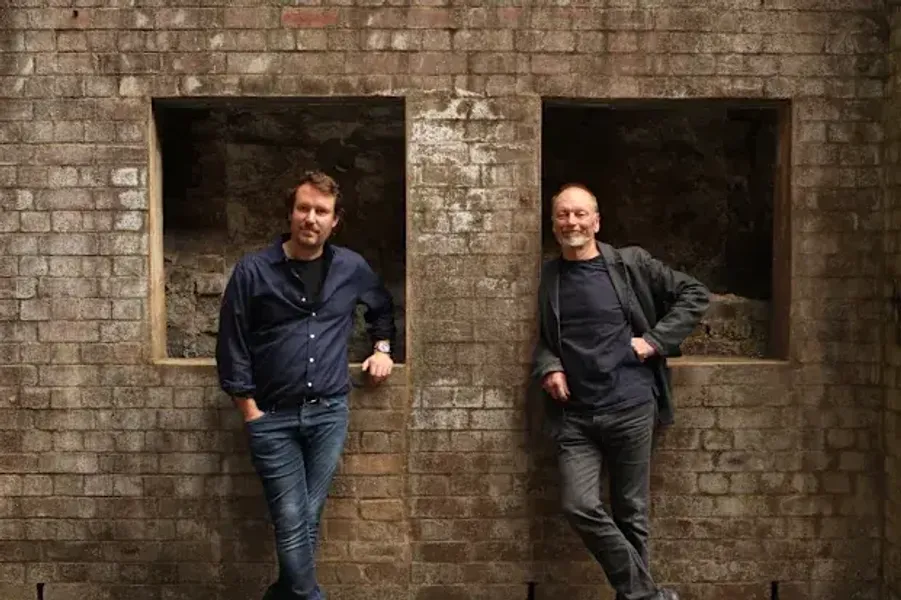
 Peter Evans, with John Bell, founder of Bell Shakespeare, 2012. Photo by Jacky Ghossein
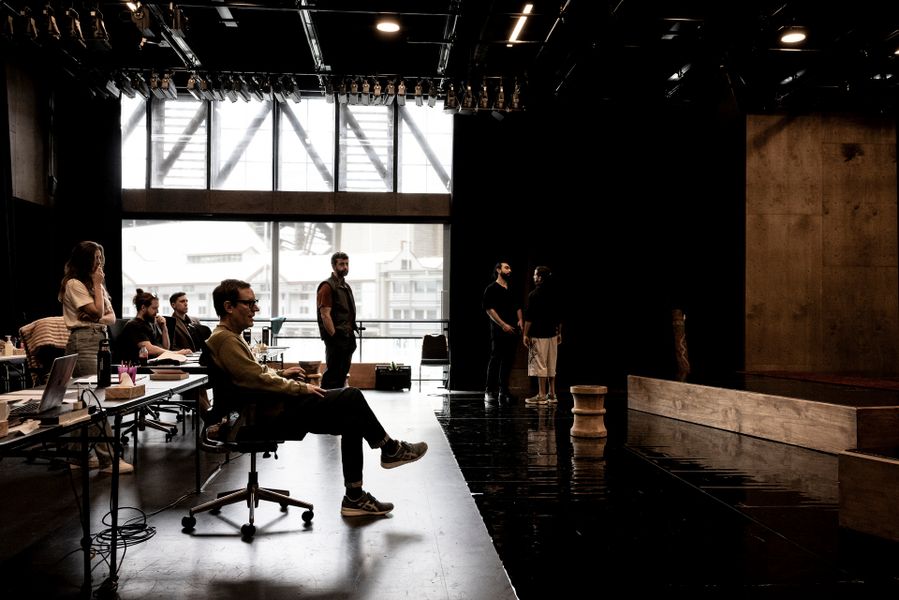 Peter Evans in rehearsals for Bell Shakespeare’s Romeo and Juliet, 2025. Photo by Brett Boardman
John Bell’s retirement and succession
Shakespeare’s The Tempest is known for being (most likely) the writer’s last, marking his retirement,t. In 2015, John Bell AO OBE coincidentally mimicked his hero by closing his career at Bell Shakespeare as the director of this play.
“Now my charms are all o’erthrown,
And what strength I have’s mine own,
Which is most faint. Now, ’tis true
I must be here confined by you,
Or sent to Naples. Let me not,
Since I have my dukedom got
And pardoned the deceiver, dwell
In this bare island by your spell;
But release me from my bands
With the help of your good hands.
Gentle breath of yours my sails
Must fill, or else my project fails,
Which was to please. Now I want
Spirits to enforce, art to enchant;
And my ending is despair,
Unless I be relieved by prayer,
Which pierces so that it assaults
Mercy itself, and frees all faults.
As you from crimes would pardoned be,
Let your indulgence set me free.”
Prospero’s farewell speech, The Tempest (Act 5, Epilogue)
With the retirement of Bell Shakespeare's founder and namesake, John and the board had to decide whether the company would continue or retire with him. For John, it was a no-brainer. In his mind, what he had built was greater than himself, and it was important to continue the work he had set out to do.
The next consideration was who would succeed him as Artistic Director. Bell Shakespeare was uniquely placed as a company that performed almost exclusively the works of Shakespeare, which is, according to former Board Chair Ilana Atlas, ‘the niche of all niches.’ Finding someone who not only had the skill and talent to lead the company, but was also happy to work with this limited catalogue would not be an easy feat.
The decision finally landed on Peter Evans, a theatre director from New Zealand who had a long-running relationship with Bell Shakespeare. Peter was first introduced to John Bell in 1996 after Lucy Bell, John’s daughter, mentioned meeting a ‘Shakespeare nut’ at a camp for student actors and directors. Peter was eventually also connected to the company through his brother Richard Evans, who had served as General Manager of Bell Shakespeare in the late 1990s. Peter was invited to be the Assistant Director of Steven Berkoff’s 1996 production of Coriolanus, and in 1997, he directed the company’s regional tour show, Macbeth.
When John was planning his retirement, he called Peter to invite him to take over as Artistic Director of Bell Shakespeare. After careful consideration, Peter agreed. He became John’s Associate Artistic Director in 2011, then moved to Co-Artistic Director in 2012 and at the end of 2015, replaced John as Artistic Director of Bell Shakespeare.
Key to a successful transition like this one was introducing Peter’s presence as a permanent fixture of the company without losing the support they had worked so hard to establish. There is always a risk that a company like this will lose significant support with the retirement of their founder, and Peter, the board and the General Manager at the time, Gill Perkins, were nervous.
One of the defining features of Bell Shakespeare is the company's relationship with its supporters as true believers of not just John Bell, but the mission and vision of the company. This meant that despite any nervousness, their supporters remained behind the company and carried it through. Since the transition happened 10 years ago, Bell Shakespeare has not just survived, but is flourishing, establishing their permanency in the Australian theatre scene.
Peter Evans, with John Bell, founder of Bell Shakespeare, 2012. Photo by Jacky Ghossein
Peter Evans in rehearsals for Bell Shakespeare’s Romeo and Juliet, 2025. Photo by Brett Boardman
A thousand natural shocks was written by Beatrice Waller, a Master of Museum and Heritage Studies student, who explored the history of Bell Shakespeare through oral histories in 2025 as a part of her degree. Oral history refers to the process of recording history in the voice of those who witnessed it and consists of conversational interviews recorded in audio format. Most of the interviews included in this publication were recorded by Beatrice, excluding Tim Cox, who was interviewed by Master of Museum and Heritage Studies student Andy Muir in 2021.
This project was completed in collaboration with the University of Sydney, partner of Bell Shakespeare.